Research
RESEARCH
Reviewing Grizzly man
The film frankly considers the deaths of Treadwell and his girlfriend, attacked by a bear under apparently harrowing conditions. The film includes several images of bears menacing or fighting with one another, as well as some "confessional" moments by Treadwell that might disturb younger viewers (he's very emotional, uses frequent foul language, and behaves in a paranoid manner). Throughout the film, Herzog argues with Treadwell about "nature" -- where Treadwell respects the wildness of "his" bears, he also see them as noble, even friendly creatures.
For this documentary , i deeply analysed the director , Werener Herzog as He was the mane backbone of the project . not the main character , timothy treadwell. which is bizarre as a vast majority of the video is filmed my treadwell.
Grizzly Man shows the ideal footage of a man whose courage and determination got him his calling. He proved that bears are not killers, and brought some brilliant footage in the making. This truly is a beautiful nature film, and I recommend it for any nature lover. Although, yes, Timothy was somewhat loony, but I respect his decision in life. I know that there's a one and a million chance that someone will survive thirteen years without weapons among one of the most dangerous animals on this planet. I enjoyed this film and admired Treadwell's skill, devotion, and humor. This film is truly a masterpiece. The stuff he captured is simply wonderful. HOWEVER, I do not respect Herzog. I think he twisted it around a bit. Some directors do that. He probably made Tim look more than he was. I wish that this movie was more about the nature and beauty Treadwell captured rather than the stupid opinions of Herzog.
This documentary is almost like a film in someways , and that is not what i am trying to present in mine. the difference between a documentary and a film is that that a film is scripted and acted, whereas a documentary is more factual and informative. Herzog thinks otherwise: “I don’t really make a clear distinction between documentaries and feature films, there’s a blurred line because I stylise documentaries, sometimes I even invent. I even sometimes try to dig into something much deeper than the actual truth . somehow it is confused about fact and truth,. Grizzly Man is a typical Herzog film, but also unusual at the same time, some notes i found it explains that Herzog is known for his cruel control during film making. Grizzly Man, however, is for the larger part shot by someone else. Namely, Timothy Treadwell.

For my documentary project, I need to research why documentaries are made and looked at. It's important to make sure your documentary is interesting as well. Your target audience is vital.
codes and conventions are used together in any study of the genre – it is not enough to discuss a technical code used such as camera work, without saying how it is conventionally used in a genre.
For example, the technical code of lighting is used in some way in all film genres. It is a convention of the horror genre that side and back lighting are used to create mystery and suspense. This is an important part of any horror movie.
For my project, I am doing a documentary on our generation's views of politics. On the whole, my research so far has shown that we a ' deprived ' with knowledge of politics and voting. Most teenagers would turn a blind eye to politics maybe a few years ago, but in this documentary, I am analysing whether the interest of politics has actually increased, maybe this is because of the jokes around ' Brexit ' but nonetheless, it seems it has risen.
But looking at articles its as if we are being targeted as not caring, but is this because we are not taught enough?
''To start, a shockingly few number of teenagers have any interest in politics. According to a study conducted by Harvard University, 60% of teenagers pay no or casual attention to the news on a daily basis. In addition, according to Gallup News, 70% of teenagers have the same political beliefs as their parents. To be clear, there is nothing wrong with teens agreeing politically with their parents. However, it becomes a problem when teenagers blindly accept everything their parents say, and do no outside research of their own. Parents are great to talk to, but they don’t know everything, and if teens only get their political beliefs from their parents, they will most likely get a very one-sided view of the world''
- mill valley news

Mill valley news are a pretty big news manufacturer , and to say this , is pretty bold. I need to make sure in my project that i counter this statement but also make it equally balanced. What i mean by this is that i make sure this documentary is equal in both arguments.
knowing that 70% of teenagers tend to share the political beliefs of their parents i will ask a similar question in my interviews to question why ?
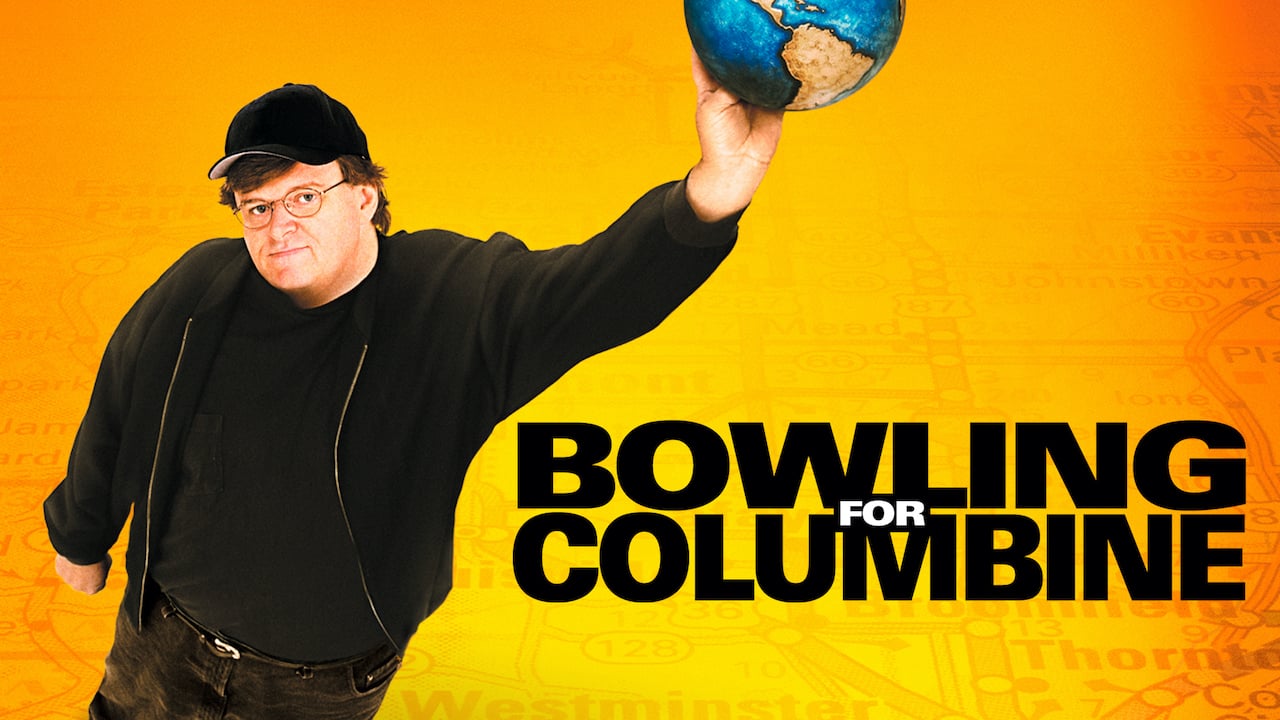
BOWLING FOR COLUMBINE
Michael Moore's "Bowling for Columbine" uses of techniques to persuade the viewer of his opinion. Michael Moore tries to persuade the viewing public that the American gun culture is damaging to society, and is dangerously out of control. , it also explores how the land of the "American Dream" is riddled with unhappiness and violence. The documentary is primarily focused on the incident, which unfolded on April the 20th 1999 in Columbine High School, where 11 students and 1 teacher were killed.
In my opinion, the most persuasive sequence in the documentary is the “Wonderful World” scene. This scene is to prove that Americans do not use weapons in self-defence, as many would argue, but use weapons aggressively. This scene also tries to place the events of September 11th in the idea of a worldwide perspective. Americans view this activity as a major world tragedy, yet they regularly destruct and destroy countries on a regular basis.
The scene's position in the film and Moore's technique of cutting between scenes is important, i could use this in my documentary. Before the sequence is a press official from the man explaining how most of the workers are fathers of children who go to Columbine school. Therefore, Moore is creating a link between the children's upbringing in a culture of guns and the occurrence of the shootings. therefore, this interview supports Moore's view that there is a link between the worldwide wars and these isolated incidents.
Michael Moore has the power to turn people against each other and if if you happen to disagree on his opinions as a documentary filmmaker but with Bowling For Columbine I truly believe he shows a time period of American history better than any other docomentor. He asks some very difficult questions here that ultimately can't be answered definitively but as a conversation starter this is perfection.
The saddest thing about it though is that 10 years later nothing has really changed. People are still being killed by guns at record paces and no serious effort is currently underway to change that. And that may be the saddest fact of all. But bowling for columbine helped me out in finding out how you can answer an argument , make a statement. This is what i will do in my documentary , making sure i prove the point that teenagers do care.
SURVEY :
I did a survey to get a backbone on what students our age understand about politics. The reason why i did this survey is because i wanted to get an outline of what is to come with the interviews i will hold.
1. this first diagram tells you the age target i am analysing in this project , its important i stick to this as i going off track can bore the audience. Some of these questions will also be used in the documentary.


PEER FEEDBACK :
The framing of the interview was great as he wasn’t looking directly
at the camera and was on the right-hand side of in the frame which make the
layout more interesting of a composition to watch. Although consider the amount
of headroom.
The questions asked were relevant and you asked questions
branching off the previous question which made this a good interview and showed
that you were listening to what the interviewee was saying.
All the questions you asked were relevant and they were
answered well in the interview and they were clear answers from the interviewee.
This was a good interview however the sound was too quiet to
hear the questions asked and the answers given. This might have been because the
recording level was too low – wear headphones when recording to monitor the
levels.
The white balance was good it was the right tone and didn’t
have any off colours. Consider what the background will communicate to the
audience.
The exposure could have been brighter as it was a little
dark unless that was what you were going for. There is a blown-out highlight on
the right, make sure that you are balancing the light.
As I said before the framing was good as you followed the
rule of thirds.
The focus was good there wasn’t any blurry parts it is in
focus all the way through the interview.
Where would you go next? Another interview? If so who? What about
cutaways?
You could film people voting maybe or news reports. Maybe you
could interview an adult, someone who knows quite a bit about politics just
some ideas.
CODES AND CONVENTIONS IN A DOCUMENTARY
Graphics
Graphics are used for a variety of reasons in a Documentary.
graphics are normally just two lines and in a simple font not to distract the audience.graphics can be used on screen to note down an interviewees name and relation to the subject. graphics are also used to credit everyone involved in the production of the Documentary to communicate complicated information in a way for that the average viewer can understand.
Archive Footage
Archive footage is used to show a variety of views on a topic. A sound track may accompany the visuals. Chroma-key- used in interviews
Digetic and Non-Digetic Sound
Sound whose source is visible on the screen or whose source is implied to be present by the action of the film Voices of characters, sounds made by objects in the story or music represented as coming from instruments in the story space. Diegetic sound is any sound presented as originated from source within the film's world Dietetic sound can be either on screen or off screen depending on whatever its source is within the frame or outside the frame. Digetic and Non-Digetic Sound is used to represent emotion or a topic.
Mise-en-scene
An Establishing shot is used in most Documentaries to set the scene. The Mise-en-scene has to be consistent throughout the Documentary, and can be portrayed through the interviews, archive footage and narrator.
Editing
Documentaries contain lots of cuts because there is such a variation of interviews, archive footage etc. Conventional editing is used, which means in the final production only answers and no questions will be on screen
Narrator
A narrator is used to move the narrative along. They also are used to push and idea or a view on the topic forward. A narrator is important to hold the narrative together. The gender of the narrator depends on the topic and target audience. The tone of voice, accent and vocabulary of the narrator all depends on who the programme is aimed at. Voice of God Narration - The term has developed to describe the use of voice-over in documentary films.
MODES
The Poetic Mode
experience, images and shows people the world from a different set of viewpoint. They are mainly loose and abstract depicting a kind of feeling rather than the truth.
Expository Documentary
Expository Documentaries are the closest relatable to the term ‘Documentaries’. It is contrasting to the poetic documentaries in a way that expository documentaries intend to persuade or inform. It is bereft of ambivalent or poetic eloquence. This form consists the television and Ken Burns style.
Observational Documentary
Observational Documentaries focuses to observe the world and the surroundings. It originated in the 1960’s with the portable film equipment and instruments. They voiced almost all dimensions of an issue by giving the audience the opportunity to see into the subject’s most important and sometimes most keymoment.
Participatory Documentary
Participatory has common characteristics of both observational and expository. They involve the film-maker with the narrative. The film maker’s voice can be heard at the back of the camera, prompting the perosn or interviewee with various questions. the filmmaker directly impacts the crucial roles of the narratives.
Reflexive Documentary
Reflexive Documentaries are familiar to participatory documentaries in a way that they also comprise the film-maker with the particular film. However, they make no effort to investigate an outside story, unlike the participatory documentaries. Their aim is mainly to focus on themselves.
Performative Documentary
It is a unique combination of styles used to share a improtant messages to the world as well as to stress on subjects with experience. They often look into personal accounts and experience placed closed together with the historical and political concerns. This has also been referred to the ‘Michael Moore’ style, as he often depicted the social constructs of truth using his personal stories.
How can creative choices affect our perceptions?
CINEMATOGRAPHY
Filmmakers can change
the way the audience see their work, and this is hugely influenced by creative choices
of the filmmakers own. This essay will explore how filmmakers can influence an
audience by there perceptions, but we will also analyse how creative choices
can affect our perceptions as well. We
will also do the same for documentaries. The reason why I am talking about two is
because I think they are pivotal part of filmmaking which heavily use creative
choices.
Cinematography,
visuals are key when it comes to films, they give information to the audience
to and create impacts on emotion.
Cinematography
is also called as the art of moving photography. It is the aspect of filmmaking,
where a cinematographer decides which camera and lighting effects should be
used while filming scenes in a movie. This is the part of movie-making that
tests the creativity of the people behind the scenes. Roger Deakins ( a famous cinematographer
who has had huge involvement in films such as 1917 and Bladerunner) has
influenced so many films to shape them into what people would say ‘ visual masterpieces’
such as ‘’ Scott and his DP Jordan Cronenweth ( who worked in Bladerunner 2049
as editors and lightworkers ) portrayed LA mainly at night and dark dull and
eerie, Deakins however ,introduces it in daylight, but a daylight so dim and
smog-ridden that it reveals even less than those light scenes’’. This quote clearly
shows how Deakins creative choices changes perceptions in filmmaking by his
creative choices, he wants to create a visual galore for the audience to see.
Deakins was the
heart of Bladerunner 2049 when it comes to visuals; his creative perceptions
rubbed off on the audience in every way, Deakins wants the audience to see how
his creative choices have affected him and how it has influenced the film its
self. This is clearly seen in a scene in Bladerunner where ‘’K first tracks
Deckard down, hiding out in a Las Vegas that’s been abandoned since the
detonation of a dirty bomb.’’ Deakins was influenced by the sandstorm in
Australia in 2009, this clearly shows that Deakins creative perceptions had
been changed by heavy research but most importantly his creative mindset.
DOCUMENTARIES
Having a creative
mindset is key in any film or documentary, however, documentaries have certain
modes which can be moulded into any one’s creative choices. The modes are Poetic,
Expository, Performative, Observational and Participatory. We will be talking about expository , poetic ,
participatory and reflexive.
Poetic is focusing
on experiences, images and showing the audience the world through a different
set of eyes. Abstract and loose with narrative, the poetic sub-genre can be
very unconventional and experimental in form and content. The goal is to create
an emotion rather than a truth.
‘’Leni
Riefenstahl’s Olympia’’ is a classic example of how a poetic documentary emphasises visuals
to encourage the audience to understand an “inner truth” of the documentary.
The focus of this documentary is on the ‘Aryan ‘athletes representing Nazi
Germany at the 1936 Berlin Olympic Games. Riefenstahl glorifies the athletic
ability and aura of these athletes through emphasised low camera angles and slow-motion
editing . this ties in with creative choices by using slow shots to develop an
emotion towards the audience. In addition to this, Riefenstal manipulated the
sound editing of the documentary so that the background music matched with the
movements of the athletes influencing an atmosphere of power.
Expository tends
to be the mode most familiar to the audience. It is frequently used in nature
and TV documentaries. Expository documentaries use the ‘voice of God’ narration
where the author provides a scripted commentary to accompany or illustrate
visuals. They are sometimes referred to as essays films because their main aim
is to give information on their audience and explain their subject. This mode
is famously seen in documentaries narrated by David Attenborough where they
will ‘assume a logical argument’, informing the audience of what they are
seeing on screen. Expository documentaries will be heavily researched focusing
on facts rather than opinion or emotion. That is not to say that these sorts of
documentaries cannot purge emotion or shape opinions. They may talk about
controversial subjects however their aim is to inform objectively and supply
evidence. A clear example of expository
is Frozen Planet II , they use creative choices such as using wide shots to
give information to the audience about the location just like Roger Deakins did
in Bladerunner , he used cinematography to highlight certain locations for the
audience to recognise , despite they are two completely different types of media
you can see where it crosses over.
participatory mode
has become a popular type of documentary in recent times with people such as
Michael Moore, Nick Broomfield and Louis Theroux using this technique. this is also investigative filmmaking where a
question is asked, or a controversial topic is explored, and the filmmaker is
showing the audience the filmmaking process of their subject. The filmmaker can
become an important part of the documentary. This was most recently seen in the
documentary Icarus, both a participatory and performative documentary.
Participatory documentaries can be done by the filmmaker or director following
their subject around and asking questions, a technique often employed by Louis
Theroux. The filmmaker does not influence the subject but will attempt to
subjectively engage with their subject despite their personal beliefs. A clear evidential
documentary that uses this technique is ‘’Louis Theroux's The Most Hated
Family in America ‘’ Theroux using creative choices by challenging the interviewees
on what their opinions are, Michael Moore also using this creative choice. It changes
the perceptions of the audience as they are intrigued to see what happens as
the documenters could seem ‘’ rude ‘’.
Reflexive
documentaries find the way a documentary is formed. From the use of the camera
to the editing and the filmmaker themselves, there will always be decisions
that need to be made which will change the story this ties in with creative
choices as they test the way documentaries are formed and see how they change
the perceptions of the audience, whether it be intentional or not. Bill Nichols wrote, ‘’the reflexive mode will
provoke audiences to question the authenticity of documentary in general”.
Mocumentaries can sometimes fall under the reflexive mode due to their
self-awareness.’’
To conclude there
are so many ways that filmography, cinematography and all media types use
creative choices to change perceptions, films would be dull if they don’t have
creative choices by people like Roger Deakins , Louis Theroux , Riefenstahl and
Michael Moore. It is so hard to change perceptions for an audience member nowadays because most of it has already
been shown , hence why certain people are seen as ‘ geniuses ‘ because they use
their own creative choices and creative minds change the way we see media.
REFERENCES
Author Ranker Film
Article title: The Best Documentary Narrators
Website title: Ranker
Author Neil Oseman
Article title: RedShark News - Blade Runner 2049
is a cinematic masterpiece - Here's why
Website title: Redsharknews.com
Article title: Codes and Conventions documentary
Website title: prezi.com
Article title: Importance Of Cinematography and
Cinematographer
Website title: Medium
Great start to the project, Tom. You have identified the conventions of documentaries and explained how they can communicate information to an audience. What I would like to see is your research into the modes of documentary, add a description of each with advantages and disadvantages.
ReplyDeleteAs for your subject research, you have found some interesting facts. The study into the number of people that adopt the political views of their parents is interesting (although I would try and find one done in the UK), what is good is that has influenced your project by giving you something to ask people in your interviews. I want to see more of this, good work. I want to see more research into this subject and how it develops your idea, Ted Talks, Memes, new reports.